3Point1 is an Electronics Design Company that brings product design, electronics and firmware design together under one accountable team, supporting the journey from concept through to scalable manufacture.
When “it works” is not enough.
Electronic prototyping is designed to reduce risk, yet in practice, it often creates a false sense of security.
You build an early proof of concept (PoC), expecting to move forward with confidence. Only for problems to surface when the prototype moves toward production.
The prototype functions, but it does not scale.
It passes a bench test, but it does not pass compliance. It works in a lab, but it cannot be built reliably at volume. Without cyber security consideration, new medical devices will not be approved by the regulator.
This is where projects stall. Not because the original idea is flawed, but because the prototype failed to prove the right things. Proving that a device can work is not the same as proving it will work under real conditions, within regulatory constraints. That gap is where time, cost, and risk accumulate.
What leaders expect from a prototype
At a leadership level, a prototype is a critical decision point. You require clarity to justify the next phase of investment.
| What you expect | What often happens |
| Clear validation | Partial validation of isolated features |
| Reduced risk | Technical risk moved downstream |
| Confidence to scale | Unanswered questions about manufacture |
A prototype should reduce uncertainty, but without a structured approach, it often merely shifts that uncertainty to a later, more expensive stage of the project.
Challenge 1: Proving function, not the system
Most prototypes are built to answer a simple question: “Does it work?” While this is a necessary starting point, it is not a sufficient proof of a product.
A functional prototype rarely confirms:
- Stability across varying operating conditions.
- The critical interaction between hardware and firmware.
- Behaviour during edge-case scenarios.
- Long-term reliability and thermal management.
It proves a single point in time, not a complete, resilient system. A prototype can be a technical success and still result in a commercial failure.
Challenge 2: Gaps between disciplines
Electronic prototyping often happens in parts. Hardware is developed, firmware is written, and mechanical constraints are considered separately. These elements only truly meet during the first integrated build.
That is when predictable issues appear:
- PCB layouts conflict with enclosure geometry.
- Thermal performance proves insufficient for the housing.
- Firmware struggles to manage real-world hardware behaviour.
These are not edge cases but predictable outcomes of disconnected development. When systems are not designed together, they do not behave together.
Challenge 3: Speed without structure
Prototypes are frequently rushed to show stakeholders immediate progress, but that speed carries a hidden cost. Short-term shortcuts lead to long-term technical debt:
- PCB routing is rushed, leading to noise and signal issues.
- Component choices are made based on availability today rather than long-term supply.
- Firmware is populated with temporary “hacks” to meet a demo deadline.
The prototype may work, but it is fragile and difficult to build upon. What looked like rapid progress eventually becomes a cycle of preventable rework.
Challenge 4: Compliance left until later
In regulated sectors, compliance defines whether a product can legally exist in the market. Despite this, compliance is often treated as a final hurdle rather than a design input.
The result is a familiar and costly sequence:
- The prototype is completed.
- Pre-compliance testing begins.
- Failures are identified.
- Significant redesign is required.
With some work already done to reach this stage, rework becomes expensive. A failed EMC test might require a PCB layout change, which affects the enclosure, which then impacts the tooling. In a controlled programme, compliance is not a final check; it’s a constraint that shapes the prototype from day one, else delays quickly compound.
Challenge 5: No path to manufacture
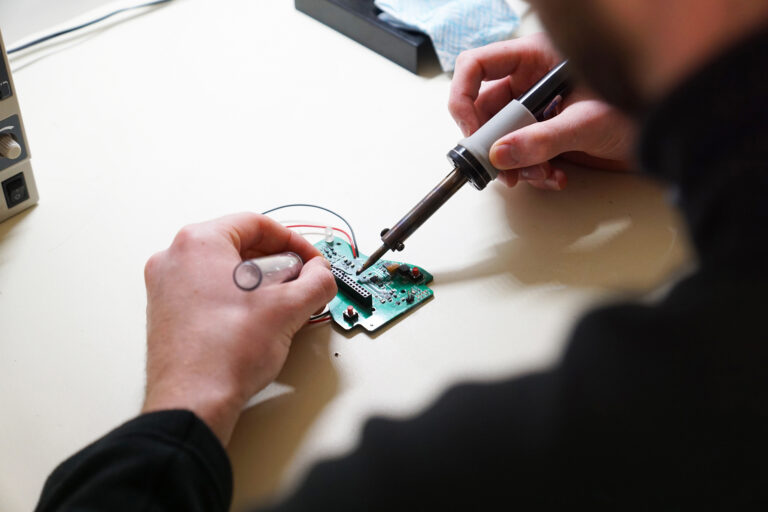
A prototype can be hand-assembled by an engineer, but production cannot. Many prototypes are created without considering the realities of the factory floor, such as component availability, assembly processes, cost at volume, and tolerance stack-ups.
This creates a disconnect.
| Prototype Reality | Production Requirement |
| Hand-assembled | Repeatable, automated assembly |
| “Off-the-shelf” components | A stable, scalable supply chain |
| Low-volume tolerance | High-volume consistency |
When manufacturing is introduced too late, you discover the design works, but it cannot be built efficiently or profitably.
Challenge 6: Firmware masking hardware limitations
It is a common temptation to use firmware to compensate for hardware instability. Firmware is used to “fix” timing issues, signal noise, or power constraints.
In the short term, this produces a working demo, but it creates deep-seated risk. The system becomes dependent on complex workarounds, increasing debug time and the likelihood of failure in the field. What appears stable on the bench is often a tightly balanced system that will fail under stress.
Challenge 7: Weak documentation and handover
Prototypes are often iterated informally, and documentation rarely keeps pace with the changes. This results in incomplete schematics, outdated Bills of Materials (BOMs), and limited test records.
This lack of clarity becomes a bottleneck when the project moves forward. Knowledge remains with individuals rather than the system, making it impossible to hand over or scale the programme without significant risk of error.
The business impact
These are not just technical inconveniences; they are programme-level threats.
- Time: Multiple prototype iterations extend your time-to-market.
- Cost: Rework increases spend without adding any fundamental value.
- Risk: Critical issues remain hidden until they are at their most expensive to fix.
- Control: Management loses visibility, and investor confidence drops.
From a leadership perspective, the primary concern is not simply whether a prototype functions. The real objective is to ensure that the prototype validates a defensible and scalable path toward a final product.
What changes with a controlled approach
Electronic prototyping is effective only when it is structured around the full system. A controlled approach ensures the prototype is a validation tool for the final product, not just a demonstration of a concept. It does three things:
1. Define the Proof
Before a single component is selected, we define exactly what the prototype must prove. This will be some combination of integration, compliance, and manufacturability. We will write and agree a test plan with the client such that expectations are set for the outcome of this phase of the work.
2. Parallel Alignment
Hardware, firmware, and mechanical design develop in unison to ensure the system is cohesive.
3. Design for the End State
Compliance and manufacturing requirements are baked into the first PCB layout.
4. Test the Output
With PCBs in hand, we will test them to ensure compliance with the outcomes specified. If these have not been met, we will iterate. The target outcome is as few iterations as possible to meet the input requirements.
What success looks like
A professional prototype does more than function; it provides a demonstrable path forward. You gain visibility into:
- How the system behaves under real-world conditions.
- Exactly how it will meet certification requirements.
- How the design will transition into volume production.
You move from saying “it works” to saying “it works, and we can build it reliably.” That is the difference between simple progress and commercial momentum. We do not look to prototype the minimum feature set. By beginning with a full understanding of system goals, we avoid rounds of extensive and expensive redesign. The goal is not the minimum demonstrator, it is the minimum viable commercial product.
Electronic prototyping is a critical stage in electronic device development, but without structure, it creates false confidence. It proves that a device is possible, but it does not prove it is deliverable.
When prototyping is aligned with system design, compliance, and manufacturing from the start, it becomes a foundation for scale rather than a detour.
Next step
If your prototypes lead to repeated redesign and delayed production, the issue is not your capability but your structure. You do not need more iterations; you need a prototype built with the full system in mind.
Contact us about delivering electronic prototyping that supports real, scalable products.